Showing posts with label Picture Books. Show all posts

Friday, July 22, 2011

The Widow's Broom


There's honestly not much for me to say about this book, except that it's super creepy and SUPER fun. A neglectful/forgetful witch lets her broom run out of juice and fall to the ground one night, and is taken in by a kindly widow who let's her recouperate from her fall in her home. The witch leaves in the middle of the night, however, leaving her supposedly dead and powerless broom behind. The widow soon discovers, though, that the broom is still more than capable of performing unique tasks like moving around on its own, gardening, and helping the widow take care of her home. When skeptical and angry neighbors become concerned about the broom's witchcraft and "devil's work," the widow has to take things into her own hands. It's a Chris van Allsburg book, so you know there's a nifty dose of surprise and spin to the ending as well.


This book would be a ton of fun for Halloween, but if you're looking for a deeper, more teacher-ey analysis then I would also say that it could work for a character study of the widow or a discussion of jumping to conclusions and assuming the worst.

Walking to School


This book is really interesting, mostly because it dives into a current story line that I'm ashamed to say I know very little about. Using the cultural war between the Catholics and the Protestants in Ireland, the issues of race, prejudice, and unfair assumptions are explored with a vehicle that's different from our somewhat typical go-tos of America's black versus white and Germany's Holocaust. Those examples are extremely powerful and necessary, but the truth is that these issues exist elsewhere as well. I love that this unique picture book gives teachers or parents the avenue to discuss them with a brief plot that opens many doors for discussion. What's also interesting - and realistic, I think - is that the young protagonist is able to see so clearly what the adults around her cannot: both sides of this feud see themselves as wholly pure and righteous in their actions but scrutinize every action of the other side as foul and deserving of punishment. It's just simply not the case, and even this young girl is able to see that as she listens and observes. This would be a great introduction to a unit to get conversations started with kids, and to perhaps introduce a world of other examples of prejudice from all over the world.

Friday, April 1, 2011

The Pigeon Wants a Puppy


How could you possibly go wrong with a Pigeon book? You can't.


We've already seen Pigeon declare his love for public transportation in Don't Let the Pigeon Drive the Bus, but in this one he's moved on to puppies. Just as persuasive as you would expect, Pigeon tries his best to convince you that he will be a responsible ("I'll water it every day!") and loving ("I'm a puppy-lovin' pigeon!") parent. When logical reasons such as those don't seem to work, he resorts to a sudden and hilarious rant ("I WANT A PUPPY!"). He really pulls out all the stops on this one, showing the full range of persuasive techniques. His arguments have improved slightly but he still hasn't learned much in the ways of successful persuasive angles and effective techniques. He doesn't get a puppy just like he doesn't get to drive the bus, but you might be surprised with why he doesn't get the puppy. This one's just as hilarious/entertaining/voice-filled/persuasion-filled as any of his others. The Pigeon doesn't disappoint. How could he?

Wednesday, March 30, 2011

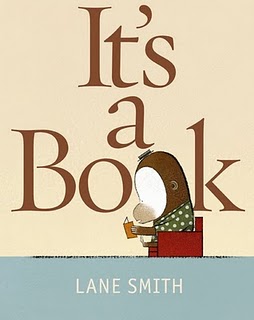
It's a Book


Lane Smith strikes again. I love John, Paul, George, and Ben, and I love The Happy Hocky Family Moves to the Country, and now's the time to share my love for It's a Book. I found this one in a blowout sale at a Borders a handful of weeks ago, and had it in my hand to buy it, full of excitement, until I walked around a corner and saw the line. I've been in some lines in my time, but this line was absurd. It was like WalMart on Black Friday. So I sadly put it back on the shelf and vowed to buy it from Amazon, where no lines are involved.

Simple and to the point, It's a Book points out the flaws in our generation of technology and virtual gizmos and such. Our poor children don't know what books are. Or how to read them. Perhaps it's a little bit of an exaggeration, but I think the premise is based in a lot of reality. We text and tweet and Facebook and email and Skype and bluetooth and gchat and ichat and....etc. We download books onto our Kindles/Nooks. We really are a generation of instant gratification and the newest toys. We really like our toys. And books aren't really toys (not for the general person anyway. The floor of my room shows that I obviously am an exception.) Lane Smith addresses this issue with Monkey and Donkey. Monkey has a book. Donkey isn't quite sure what it is. The plot thickens.

This book is hilarious, witty, clever, and obvious in its message. We need to take a step back and see what it is we're abandoning for the sake of the next best thing. For goodness sake, kids need to know how to read a book. I think it would be an awesome first or second day introduction to the school year, in which the teacher sets the stage for lots of reading, none of which will take place via text message.

Fun fact: the book is on youtube [HERE] courtesy of Macmillan.

Tuesday, March 29, 2011

The Happy Hocky Family Moves to the Country


Just like the "Voice" tag in New Socks is kind of a stretch, the "Growth Mindset" tag in this one is a little dicey. I'm going to stick with it though, and I'll explain why. Lane Smith describes the life of the Hocky family after they move from the city to a broken-down farm house in the country. As someone who has lived in the country for about 13 years, I find a lot of the humor in this book to be, well, humorous. There's a whole lot of truth in it. Between the description of leaves in the fall, the chili cook-offs, and the abundance of "furry" creatures such as squirrels and skunks, the country is successfully captured. I have to say that my favorite page, though, is 52, which shows the house and yard covered with snow with a caption that says "In the country there are lots of new games to play. This one is called FIND THE DRIVEWAY." After last year's blizzards, this was a game we played often at my house.


The growth mindset comes in during a couple of the vignettes, in which the Hocky children either become dejected with a failure or decide to take their failure and try again. Some of the vignettes - the ones where the children become dejected - demonstrate fixed minset, while some of them display growth mindset, but in the very end of the book each family member has an opportunity to show growth mindset at last. It's subtle, extremely subtle, but I like it. And I think I could use it. Bottom line, though, this book is a really funny time.

New Socks


Honestly, the "Voice" tagging for this one is kind of a stretch. You could easily use this book as an example of voice, but the theme of this book is humor. Absolutely hilarious, just-for-fun, humor. What I'm about to say is truly big: New Socks is as funny as a Pigeon book. Blows your mind a little bit, doesn't it? I know.


There's not a lot of plot; the little guy's got some new socks. That's pretty much it. Oh, and he really loves those socks. He talks about the socks for page after page, sharing his love for his snazzy new accessory as if he's describing a million bucks. All I can say is that if you're in need of a good laugh, find this book. I hate spoilers so I'll share what the back of the book says instead of anything inside it:


"Imagine the best book ever. This is better. It's about me and my New Socks, and it's about me. Read it. You'll like it."


Pretty much sums it up.

Learning to Fly


This is one of the best picture books I've read in a while, and that's really saying something. I love picture books. But I also love growth mindset and books that display it, and this one does that impressively well. It also doesn't hurt that the drawings are awesome and penguins are adorable.


The narrator stumbles across a penguin who says that he decided that he wanted to fly. So he did. And as he flew he saw some other bird who told him that penguins can't fly. And he fell. The penguin wanted to fly, reached his goal, and then allowed someone else who didn't believe in him ruin everything. How often do we do this to our students? How often do we destroy their fires by believing that they aren't capable? They know when we don't believe in them, and they believe it themselves. Thankfully, the narrator believes in the penguin; he sets up a training program and does everything he can to help the penguin fly again. Unlike the first time, though, nothing works. It's not until the last page of the book, when they spot a penguin colony flying overhead, that the penguin believes once again and easily takes flight. Unfortunately, our students may need an incredible amount of convincing once they've been taught to believe that they're incapable of succeeding. The narrator of this book did everything he could to help the penguin but the final ingredient for success only came when the penguin believed it about himself. This is the case with students, too, and we need to be patient as their educators. It may not be an instantaneous change, but we need to do everything we can to encourage them so that when the moment comes and it clicks and they see what they're capable of, they'll fly just like the penguin.

Mia's Story


This is a genuinely unique story. With beautiful illustrations that provide an intimate sketchbook look and a writing style in the form of a personal narrative, the reader feels as though they are looking over the shoulder of the author as he writes. Taking place in the mountains of Chile, Mia's Story highlights a young girl's determination that embraces every element of her life. Whether caring for her new puppy, searching for that puppy after he disappears, or nurturing a crop of flowers to sell at the marketplace, Mia approaches life head-on. Her family's life in their poor village is difficult and she faces several hardships throughout the book, but she remains strong and focused. Mia finds happiness in each of these situations, whether taking a moment to breathe the clean air on the top of the mountain or harvesting an accidental crop of wildflowers to help her family. An somewhat subtle but sincere example of growth mindset, Mia demonstrates the benefit of seeing good in every situation as well as the results that can come from genuine effort.

The Red Chalk


Main character Sara has a piece of red chalk that she thinks is boring. After successfully tricking a friend into trading his marbles for her chalk - she says it has magic powers - she quickly becomes bored with the marbles and seeks her next victim. This pattern continues, but the interesting element is that she is always bored and unhappy with what she has and is continually on the hunt for what everyone else has, but each friend that she trades with is completely content with their new toy. It doesn't matter to them that it's just a normal piece of chalk...to them, it really does have magical powers. Why not? They all take their typical object and have the time of their lives with it while Sara remains completely unhappy. In the end, Sara realizes the great thing she had originally with the red chalk, and is finally content.


This book is adorable. The illustrations are cute, Sara is cute, and the lies Sara comes up with to trick her friends are...imaginative. For me, though, this book is an excellent example of growth mindset. Our students look around in the classroom and in the gym and in the lunchroom and they see what everyone else has. Everyone else is smarter, stronger, more popular, more artistic, more musical...fill in the blank. They wish they could trade talents - or just have one of the talents - of their peers and they fail to see what they have already. But everyone has talents, everyone has abilities, and everyone has the ability to learn. All of Sara's friends traded their items with Sara based on the premise of the lies that she told them. But when they realized that their item didn't really make you a genius or give you three wishes, they had just as much fun with the item anyway. They saw the item for its true potential, not just what they were told at face value. Just like Sara eventually realized that she should have seen the value of her red chalk rather than chase after what everyone else has, our students can learn that they already have the abilities to be whoever and whatever they want to be.

Wednesday, February 23, 2011

Harold and the Purple Crayon

Could there be a more adorable cartoon boy than Harold? I think not. Believe it or not, I just read this classic for the first time about a month ago and thought it was the cutest thing I'd read since I myself was a toddler. When I had to do a children's book assignment for one of my classes this week, I knew the Harold was my boy. This book is, in my opinion, excellent for instilling inspiration and personal motivation in students: Harold wants to go for a walk with his crayon, so he draws his walk. He makes his own street. He makes his own moon and his own picnic and his own sailboat to rescue himself and his own apple tree. When Harold travels all over with his crayon, creating his own adventures, and wants to go back home, he draws his house and he's home. Basically, Harold decides that something should exist, so he creates it himself. When unforseen scary times approach - Harold accidentally draws waves that swallow him up and try to drown him - he doesn't loose all hope and give up...he draws himself a sailboat so he can pull himself out of the scary water and sail back to land. When he accidentally falls off a cliff that he never drew the other side of, Harold calmly draws a hot air balloon and floats away. What a perfect conversation starter for students who have grown up thinking that they have been provided with a concrete set of intelligence or skill or talent and that they lack any control over their success. I think it might be even more perfect for a conversation regarding how to react when bad things surprise you. Harold didn't give up. Harold simply created his own escape plan and turned it into something good. If you aren't so interested in this particular route for instruction, I think this book also works beautifully for introducing unconventional figures (historical, scientific, fictional) who broke the rules and thought a bit nontraditionally but who made a huge difference in their given field. If none of these interest you, you could perhaps discuss Harold's impact on the environment as he travels through his drawn world...but that might be a little bit of a stretch...

Tuesday, February 22, 2011

Henry's Freedom Box


I read this book several years ago with a seventh grade boy I was tutoring, and we both loved it. When I was given a gift certificate to Barnes & Noble yesterday for my birthday (always my favorite gift), I knew going into the store that I wanted a picture book. After browsing the picture book section and having to tear my heart away from several others, I knew that this was the one I needed to add to my bookshelf. This book is awesome. The illustrations are beautiful, and the story is heartwrenching. The true story of Henry "Box" Brown, the book starts with Henry as a child, ageless due to his lack of an acknowledged birthday because he is a slave. As the book progresses, so does Henry's life. The small boy grows into an adolescent, then a teenager, then a married man with two small children. When Henry's master sells his family, he realizes he will never see his loved ones again and that his only option is to find freedom through the Underground Railroad. Historically acurate and engaging, this book would be great for an English classroom or a History classroom.

Friday, February 18, 2011

Except If


Here's another great one for perspective and how one small change can lead to a multitude of changes. The reader starts out looking at an egg, and the obvious statement that an egg is a baby bird...except if it's actually a snake. The book continues in similar fashiong, leading the reader in one direction - that should so obviously be the truth - until it flips the tables every other page with an except if...It's a fun and quirky little book, with a range of possible applications. [Sidenote: that's what I love about ambiguous picture books. Sometimes picture books tell one clear and purposeful story, and they're great because that's the purpose you need them for. But other times picture books are completely vague and strange and openended, and you can use them as a discussion starter for almost anything you want. You control the spin and the application, which is quite empowering as the big adult holding a tiny children's book. Plus, clearly, they're super fun. But back to Except If...] This one's particularly good - off the top of my head - for perspective, dealing with changed circumstances, the curveballs of life, "everything is not what it seems"...etc. It's also fun because it can easily fit into any content area [except maybe Math. I'm bad at finding ways to relate things to Math.]

John, Paul, George, and Ben


I had heard about this book for a while - seen it in stores, heard it referenced in the one day I spent in my accidental enrollment in an elementary ed. course, etc. - and pretended to know all about it but didn't really. When my professor brought it out the other day to show us, I secretly got really excited because I could finally have an actual wealth of knowledge about this popular little picture book. And honestly, it's really cool. Since I am going to be licensed to teach both middle school English and middle school History, I'm pretty interested in finding books that can span both of those subjects. [I'm really interested in finding books that can span all subjects, for the record.] This particular book follows the childhoods of four of our Founding Fathers, John Hancock, Paul Revere, George Washington, and Benjamin Franklin. These childhoods range from being semi-fictional to [as far as I know] very fictional, but they're extremely humorous and they all relate to things we know as fact about those Founding Fathers. For example, John Hancock has a hard time not writing his name extremely large on all his elementary papers, and Paul Revere shouts constantly as a young boy. It's cute and it's very comical, and it would be a great way to introduce some funny post-unit material to students after they've learned the necessary information to "get it." All the little stories in this book are funny because we already know about what the grown men were like and what they are famous for; the book wouldn't be nearly as interesting to students if they hadn't learned those facts yet. There's something very powerful to a middle school student, though, to be able to watch a movie or read a book that has references to what they've learned in school and to get the reference. This book provides a great tool for that.

Rhyming Dust Bunnies


This book is completely adorable and completely hilarious. As you could imagine by the title and the image on the cover, it's a short picture book about four dust bunnies who like to speak in rhymes...except Bob, the difficult one. As the other three dust bunnies - Ed, Ned, and Ted - speak in perfect rhymes to get their points across, Bob continues to be a problem by speaking out of rhyme. Exasperated, Ed, Ned, and Ted correct him each time...until Bob turns out to be relaying a very important message.


Honestly, this book takes about three minutes to read out loud, start to finish. But the possible intents and messages to relay to kids or students seem endless. Bob is an outcast and nonconformist who is the only one willing to speak out of turn in order to accomplish something. Because of this, Bob goes unheard and mildly shunned by his peers. They roll their eyes and correct him and think that's he's maybe not all-together with it. But Bob, in the end, is the only one who's got it right. I know this may seem like a lot to extrapolate from a picture book that I've already confessed takes a brief three minutes to read, but seriously: it's a good one. So funny and so entertaining while also containing incredible potential for a conversation starter in a class of students. [Plus, isn't Bob one of the best names in the whole world? Don't agree? You clearly need to see this movie.]

Zoom

Banyai's books are typically unique in the fact that they are wordless, and rely heavily on messing with your perspective on a situation. Zoom doesn't disappoint, starting with a very zoomed (ha) in drawing of something you're not quite sure what it is. Then with each page, you zoom (ha again) out a little bit more. You keep thinking that you have it all figured out but then there's another page and another and another. Basically, there are a lot of "aha" moments. And a lot of predicting. It's awesome :)

I would say that this book would be great for a million different instructional reasons, but the obvious ones that come to mind are: predicting, perspective, needing to see the whole picture/both sides, etc. etc. But it's flexible enough that you could morph it into lots of different things.

Eats, Shoots and Leaves


This book is one of the most fun things I've read in a long time. Super short and taking less than ten minutes to read start to finish, this picture book gives English teachers an awesome way to explain the purposes of the comma. Each two-page spread has the same sentence, altered only by the existence or non-existence of a comma...and the differences are hilarious. Each situation is illustrated with funny and engaging illustrations. Students of all ages - we were laughing out loud in my college class - would find this book funny, and wouldn't be able to help learning a valuable lesson about the placement of commas and their effect on the structure and meaning of sentences. [Funny, but I'm very aware of my comma placement in this post...] Highly recommended!

Friday, February 4, 2011

The Butterfly and Rose Blanche

I stumbled across these books yesterday kind of on accident, but I am so thankful I did. The idea of a picture book about the Holocaust is disturbing and intriguing, and both books detail the events of this tragic time in the world's history from extremely different perspectives and with painfully different conclusions.


The Butterfly, by Patricia Polacco


In this story, Monique lives in war-torn France. Nazis are everywhere and the young girl fears the violence and oppression of the men in the "tall boots." She wakes up one night and sees a girl, who she assumes is a ghost, sitting on the end of her bed. As the story progresses, she sees this girl more and more, and eventually is able to speak to her one night before the "ghost" disappears. The girl describes that she is actually a Jew living in hiding with her family in the basement of Monique's house. Monique and the girl form a friendship throughout the rest of the story, until a neighbor sees them playing through a window and Monique's mother is forced to help the girl's family relocate to a new safe house.


The Butterfly is a very interesting story describing a point of view that we are familiar with in regards to World War II, but from a somewhat new angle. To look at a country occupied by the Nazis through a child's eyes is intriguing, as well as to see her come to terms with the concept of hiding Jews in her home in order to keep them safe. The progression of the plot is endearing and engaging: you easily become afraid for the characters as they are forced to relocate and as they attempt to avoid being captured by the Nazis. The ending is sweet, though, and encouraging; both you and the characters are left with a feeling of hope that everyone is safe. It's a great book with a sweet story and an interesting twist on a history we are commonly familiar with in regards to World War II.


Rose Blanche, by Roberto Innocenti

Rose Blanche is a young girl living in Germany during World War II who has an up-close and personal perspective to the actions of the Nazis. The beginning of the book details several encounters with Nazi soldiers in which Rose views trucks and trains transporting soldiers and machinery off to war, but several strange things that she accidentally witnesses in the middle of the story cause her to question and wonder what she has seen. After a moment of curiosity getting the better of her, Rose follows a truck deep into the woods where she discovers a concentration camp. Throughout the rest of the book, the young girl returns to the camp in order to slip food to the prisoners through the fence until a surprising and heartwrenching conclusion changes everything.

This book broke my heart. I won't spoil the ending more than just to say that in stark contrast to The Butterfly, it does not end hopeful or happy. If you are searching for a short picture book with beautiful illustrations and an emotional response from your audience, this is an excellent source. What I also love about it is that an entirely different perspective is offered than what might be considered common or usual; Rose is a German girl who is entirely unaware of what her country's leaders and soldiers are doing. These actions that we as modern Americans are so used to and so aware of was not broadcasted on newspaper headlines and shouted about throughout the streets during the war itself in Germany. We take for granted that knowledge about concentration camps and the hideous civilian death tolls was widespread, but it really wasn't. Because of that, this story paired with the movie The Boy in the Striped Pajamas - or scenes from it, perhaps - could be an interesting teaching tool. When collecting books about World War II or about war in general, this would be an excellent tool for varied perspectives, as well as varied responses and results.

Saturday, January 1, 2011

Don't Let the Pigeon Drive the Bus


My English methods professor read this book aloud to us last year, and we all instantly fell in love with the pigeon. She also read us Don't Give the Pigeon a Puppy, but I didn't get that one for Christmas. I DID, however, get this one for Christmas, and I love it. I literally paused Christmas so I could read it aloud to my family, and then they all fell in love with the pigeon too. Aside from being absoltuely adorable, this particular pigeon book could be used in a classroom in order to teach persuasion (the pigeon is quite persuasive, what with his big eye and his clever reasoning strategies), character, mood, or voice. There's plenty of all of those in this tiny little picture book. Kids of all ages would love it - I personally can't get enough of it - and I think that any lack of interest in a picture book would quickly disintegrate at the first glimpse of what the pigeon has to offer. Seriously, I know that this review sounds ridiculous...but you should go find a pigeon book, any of them, and read it. They are so great.

Saturday, May 22, 2010

Sit-In: How Four Friends Stood Up by Sitting Down


I found this book as part of a project I did for a class last semester. I went to Barnes and Noble looking for a different book (Freedom Summer, written by Deborah Wiles, which is excellent and I highly recommend it) but when it wasn't available in the store, I had to improvise and found this one instead. Sit-In describes the large-scale boycott of certain lunch counters during the Civil Rights Movement. One of my favorite things about this book, even though it's pretty trivial, is the unique style of illustrations. Another extremely valuable aspect of this book is the two-page factual timeline of events in the Civil Rights Movement, which is a great supplement to the historical fiction feel of the story itself.